

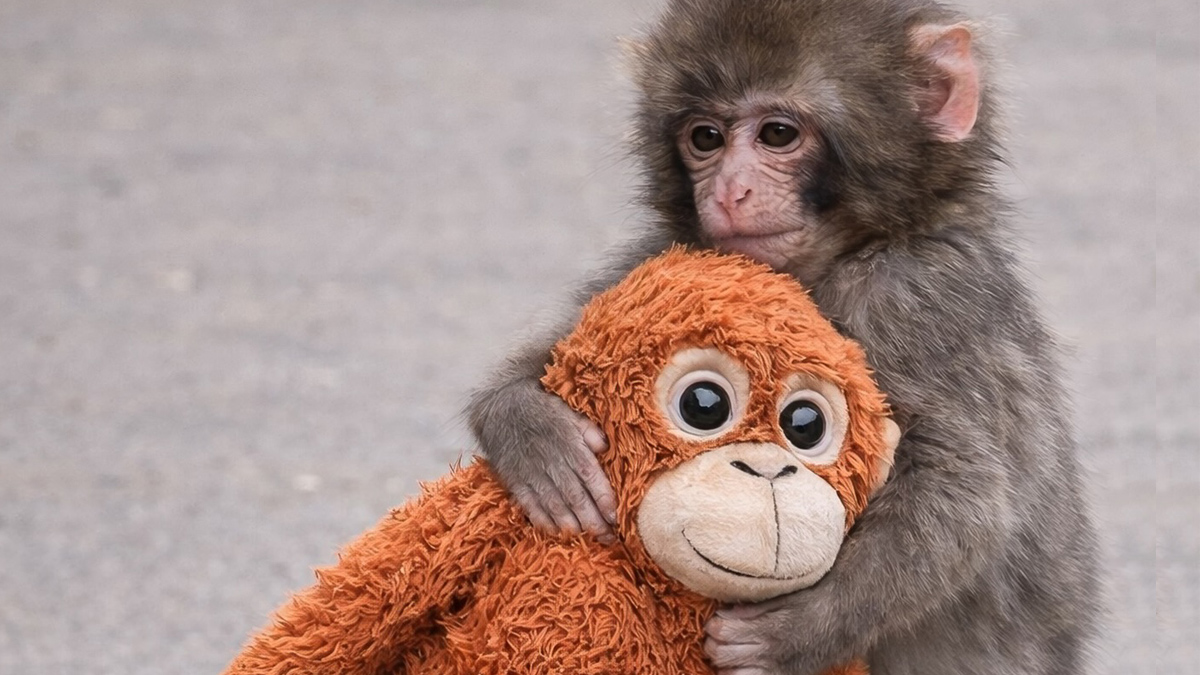
The world’s newest and youngest celebrity is not a child singer, nor is he a breakout actor. In fact, he isn’t even a human. The inarguable honor goes to Punch, a 1-year-old Japanese macaque who lives at the Ichikawa City Zoo adjacent to Tokyo, and his story has been more heart-wrenching than any other tale that could be conjured by a director.
Born on July 26th at the zoo (and named after the author of a popular manga), Punch was abandoned at birth by his mother, a decision likely prompted by the ongoing heatwave and the mother’s poor health and experience. With no other monkeys taking up his role, zookeepers had to feed him milk. And, because a monkey’s social ranking is inherited maternally, his lack of a mother placed him on the lowest rung of a ladder. He was constantly “bullied” (monkeys often display aggression to lower-ranked monkeys), and with no mother, the zookeepers took a page out of Harry Harlow’s experiment and gave him a monkey-shaped plushie, an IKEA Djungelskog.
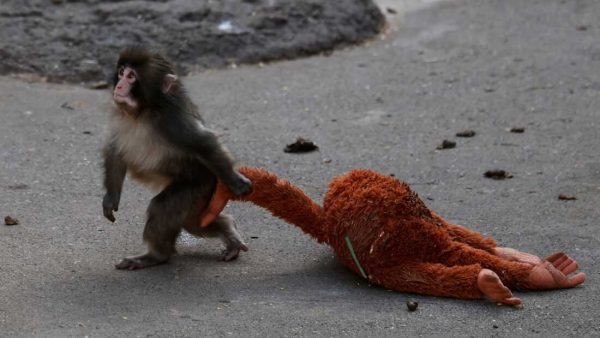
Punch soon started treating the plushie like a mother figure, bringing it everywhere and using it to comfort himself whenever he got disciplined. The plushie also helped him build muscle strength, since normally baby monkeys do that through holding onto their mother. He was eventually introduced into the large “Monkey Mountain” enclosure at the zoo, where he started off skittish, but has now become more sociable. Now, Punch relies on the plushie less, though still clings to it frequently, and other monkeys have begun providing him support, such as through grooming. He recently received a piggyback ride from another monkey, a key aspect of young monkey’s lives. And there’s even reports that he has found a companion—the five-year-old Momo-chan, whose coat bears a striking resemblance to his plushie.
There’s no doubt that Punch’s story is deeply moving. It’s a classic tale of overcoming adversity and struggling to fit in, straight out of a novel. Not only was he born without a mother taking care of him, but he was also harassed by the other monkeys—and yet he continued to push forward. Accordingly, his story has made the rounds across the internet, spreading far beyond Japan, and the zoo’s popularity has skyrocketed, with visitors more than doubling relative to last year. IKEA donated dozens of plushies to him, and searching his name on Google temporarily brought up a special effect.
Punch’s case is not entirely special. Yuji, a tiny (only 1.4lb) patas monkey who lives at the Guadalajara Zoo, was separated from his mother after she failed to care for him and was given a substitute dog plushie. He was almost immediately placed in an incubator to stabilize him, and now receives even more intensive assisted rearing than Punch did. Although zookeepers report that he is not far from ready for integration into the main pack (he has not had contact with other monkey, he has begun gaining weight and growing up, courtesy of a large team of supervisors.
The story of these monkeys are hard not to relate to. As humans, it’s easy to anthropomorphize these baby monkeys, and feel a need to care for them and protect them. Punch’s and Yuji’s bond to their plushies reminds us of our own childhood experiences of being attached to a stuffed animal.
Punch is still very young, as Japanese macaques usually live for over 30 years. Perhaps we’ll be able to check back in on him in a few years and see how much he’s grown.